Показаны сообщения с ярлыком articles. Показать все сообщения

четверг, 29 марта 2012 г.

The interview with Andrey Scherbakov, last part

The Path-walker: Why do you adhere to the Chinese style if you’ve grasped the essence of Wu Xing painting? Why don’t you develop a style of your own? Can a Russian man ever adopt a Chinese perspective?

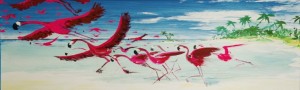
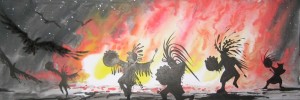
AS: It’s an interesting question. Actually, when I started painting, the Chinese style didn’t appeal to me that much. You can see it in my early paintings, there’s nothing Chinese about them.
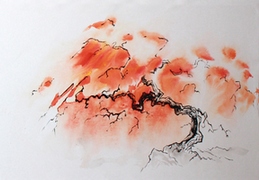
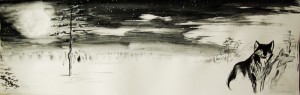
Here are two examples:
Chinese painting, feng shui, Guo Hua painting, Japanese painting, sumi-e painting, wu-xing, Сhinese traditional painting
But the more I learned, the more I felt attracted to traditional Chinese painting. It grew on me, and so began to study traditional Guohua painting and traditional calligraphy. It is the Chinese technique that I really wanted to explore in depth. This process is still active, that’s why a lot of my painting are made in the ‘Chinese style’. However, I feel that it is quite personal and there’s enough of ‘me’ in it. After all, traditional Chinese painting is full of conventions that serve to enslave consciousness rather than expand it. Besides, there’s no hiding the fact that I’m not Chinese. I was born in Russia and I’m not particularly ashamed of it. I can’t see the point of trying to be 100 per cent Chinese. I don’t see Wu Xing as an attribute of Chinese mentality. Rather it’s a certain level of viewing the reality.
The Path-walker: Recently there’s been a lot of online debate about the origin of Wu Xing painting that, some say, is not Chinese. What’s all that about?
AS: I can tell you straight away that this issue is of no fundamental importance. My teacher Maxim Parnah thought that if a painting style uses Xie Yi techniques and stems from Chinese philosophy, then it should be called Chinese if only out of reverence for the ancient Chinese culture.
One should also keep in mind that Wu Xing painting can serve as a great foundation for mastering the more authentic Guohua style. Wu Xing painting can easily be viewed as a method of teaching Chinese painting, which has been confirmed by my own experience and that of so many of my pupils.
The Wu Xing painting technique has become very popular for all sorts of reasons. At which point those who called themselves sinologists targeted us with various accusations because we got in their way. There’s been a lot of criticism from all directions. We also stopped to think about it and then approached our Chinese friends who were experts on Guohua style. And this is what they said: yes, of course the works of Wu Xing painting are part of Chinese painting. They make use of calligraphy and feature Chinese subject matter, which is quite sufficient.
Yet many of those who taught Guohua in Moscow behaved as true zealots and tackled this issue in an unbecoming way. Personally, it makes no difference to me whether it’s Chinese or not, that’s why I now don’t put these words together and talk about ‘Chinese painting” and “Wu Xing painting”. But all this is about form whereas what really matters is a point of view.
Other paintings by Andrey Scherbakov can be viewed on the website of School of Chinese Wu Xing Painting.

среда, 14 марта 2012 г.

The interview with Andrey Scherbakov,cont.

The Path-walker: Do you prefer monochrome painting or a full colour palette?

AS: To be honest, I like variety. As I have already mentioned, the Wu Xing artist doesn’t try to create a unique style of his own. The style, just as any other form, somehow transpires from the outside, in conjunction with other tasks that the artist has to face at any given time. Some of my paintings are monochrome and some are full colour. Recently I’ve been favouring the monochrome palette, but I guess this too will pass.


The Path-walker: What style of Chinese painting appeals to you most? For example, I like mountains and water but have no interest in birds. Are there any conclusions I should be able to draw from this? Especially as, all in all, there are five painting styles.
AS: Well, I’m not sure that one should be jumping to any conclusions. As we know, only amateur psychologists are keen to diagnose everyone. Yes, there are indeed five styles but they are based on a different classification system. Once again, it’s not the form that matters but the way your eye moves throughout the painting. What is really important, is the way it travels from one detail to another, from on subject to another. By the way, I also like landscapes with mountains and fog. My favourite Chinese painters are Ma Yuan and Xia Gui who lived in the Song Dynasty period.

The Path-walker: Is it true that anyone can learn to paint?

AS: Yes, it’s true. Wu Xing painting is a special technique that takes only two months to reach a very good level even if you start from complete scratch. The thing is that contemporary academic techniques, both Chinese and European, are often overburdened with details that at the initial stage are quite unnecessary. If we look at the modern psyche, we’ll see without any doubt that they tend to generate mental complexes instead of setting people free. Wu Xing painting provides the very essence of the painting skills, without any frills. That’s why it’s so easy to learn to paint from scratch using this method.
People often think that you can’t learn to paint without having some very special talent. This is absolute nonsense. Over the last few years I’ve taught Wu Xing painting to more than one thousand people. The statistics show that the only thing you really need if you want to succeed is a clear intention to learn and to spare no effort when it comes to self-improvement. The main obstacles here are laziness and intellectual impotence. They supplement each other and create the vicious circle that ninety per cent of us can’t break: I cannot, I will not, I don’t want to… Men should beware of intellectual impotence more than women as physical impotence is the next step.

воскресенье, 4 марта 2012 г.

Chinese Venice

There is a famous picture «请明上河图» painted during the dynasty Sung, it is called "the celebration of Qing Ming holiday over the city". You can see the enormous number of people on it walking along the old streets, look into the windows of palaces and village houses. You can see the picture scroll here:
When Andrey Scherbakov who loves this picture very much went to China for the first time, he had an impression there were no more places like that in modern China, modern life had killed the features of the country. But it turned out to be untrue. During the trip to China in 2011 the Wu Xing group visited two places which were traditional chinese cities on the water. In one of the cities it was possible to feel oneself a member of the picture mentioned above! As they came there at celebration of the Qing Ming holiday and saw the same number of people as on the picture.
The second place - Wu zhen city - can be named Chinese Venice, it is very romantic. It is excellent for painting traditional chinese architecture, though the city was build in 1998, it looks very ancient. 


четверг, 23 февраля 2012 г.

The Interview with Andrey Scherbakov, cont.

The Path-walker: What art materials do you use? Paper, of course, but what else? Ink, China ink, gouache paint, water colours? If using various materials, could you say in what ways they are different? Do you associate paint colours with Wu Xing? Is it important to use special kinds of brush and paint in this work? Which ones do you recommend?


AS: This kind of questions always reawaken me to the metaphysical nature of Wu Xing painting that is above all form. That’s why Wu Xing painting doesn’t require any special tools or materials. The more I practice it, the more evidence I find to support this point of view. Having said that, Chinese calligraphy brushes are best suited for applying swift brushstrokes. As a result, it looks more ‘Chinese’, so at the beginning it might help develop the right skills. Otherwise, there is a full creative freedom.
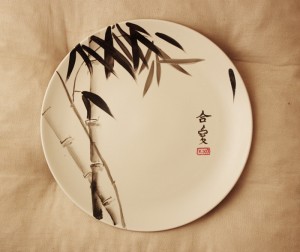
For example, in our recent master class we decorated plates and dishes:
Chinese painting, feng shui, Guo Hua painting, Japanese painting, sumi-e painting, wu-xing, Сhinese traditional painting
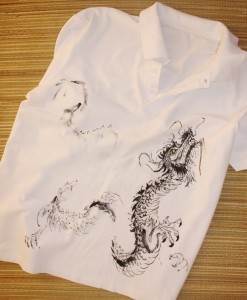
We also gave a master class where we taught the skills of painting on clothes:
Chinese painting, feng shui, Guo Hua painting, Japanese painting, sumi-e painting, wu-xing, Сhinese traditional painting
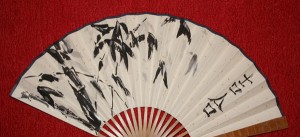
At another recent master class we painted on Chinese scrolls, fans, and paperboard:
Chinese painting, feng shui, Guo Hua painting, Japanese painting, sumi-e painting, wu-xing, Сhinese traditional painting
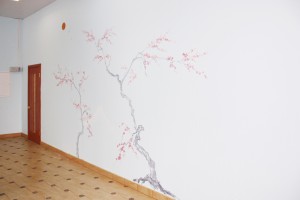
We also did some decorative wall painting as you can see above.

I would like to repeat that you can use all sorts of art materials. It can be Chinese ink, acrylic, or anything you like. Of course, there are some tricks to using various paints on various surfaces but eventually it’s all about form whereas the essence of the process remains the same. Perhaps you would like to read another of my articles that describes four types of viewing creativity.
We know that Wu Xing is linked to various colour paints. For instance, Wood is turquoise, Fire is vermillion, and so on. Some modern practices like Zhong Yuan Qigong use colourtherapy based on Wu Xing. But I prefer conscious awareness to blindly following in someone else’s steps. In my experience, I haven’t yet detected the objective links between these things. Personally, I sense that here it works the other way round. First, someone convinces himself that liver is connected to the turquoise colour, and then he starts applying it as a kind of self-hypnosis.
There might be a connection between Wu Xing and coloristics, but then we should attempt a more comprehensive approach. For instance, Gauguin’s paintings offer a rich contrast of cool and warm hues. They stir up a cauldron of emotions in the heart of a viewer, that’s why contrasting cool and warm hues is ‘Fire’ energy. But when you look at monochrome Japanese Sumi-e paintings, they often evoke a sense of peace and even sadness. That’s why contrasting dark and light colours can be associated with ‘Metal’ energy, and so on.

воскресенье, 12 февраля 2012 г.

The interview with Andrey Scherbakov (cont.)

The beginning was published here

The Path-walker: In announcements about Wu Xing painting this technique was described as having the benefits of art therapy. Could you tell us more about this?

AS: Yes, it really has a similar effect. Professional psychologists like Julia Ziema have also noted it. Many psychologists now employ this technique. I know that in Kiev the local art therapy association uses Wu Xing painting in their professional work.
The first level of influence provided by Wu Xing as a tool of art therapy is a correlation between the body and psychology. Relaxing physical tensions helps to relax psychological tensions. This has been well-established in theory and practice of the body-oriented psychophysics.
The second level of influence is movement. When we loosen up, our movements become less constrained and so we learn a new of interacting with reality. This is where the effect of Wu Xing painting can be easily identified and traced. For instance, some people can be too direct and so they end up slapping others in the face with their comments and opinions. It might be that they’ve never heard of flexibility, or perhaps they’ve long forgotten what it is. This often happens to women who have abandoned their femininity. Such a person can only use the “Wood” brushstrokes, tough and direct, whereas the flexible “Metal’ might be something new for him or her to try. If mastered properly, it could become a big step forward.

понедельник, 6 февраля 2012 г.

An overview of Wu Xing painting - from the interview with Andrey Scherbakov

Chinese painting, feng shui, Guo Hua painting, Japanese painting, sumi-e painting, wu-xing, Сhinese traditional painting
Today I’d like to offer you a big interview jam-packed with information. Much to my surprise, it has turned out to be much bigger than I planned. In fact, it’s simply huge. Still, we’ve decided to keep it as one piece because a single posting usually works best. If you are not familiar with the concepts of “Chinese painting” and “Wu Xing”, I suggest you read the previous article called “Wu Xing Painting” where you’ll find lots of useful information, images, and a video presentation. But if you have already done that, make sure you don’t miss this one. Make yourself a cup of tea or coffee or whatever you would like to drink, find a comfortable place to sit and go for it.
The Path-walker: Andrey, could you please tell us what appeals to you in Wu Xing painting and why you practice it? What value does it have, and why do you prefer it to other techniques?
Andrey Scherbakov: It’s an interesting question. First and foremost, Wu Xing painting guides me on the path of spiritual growth. I see it as a tool for self-development. It’s also a way of self-expression and an art technique, but that comes second. Wu Xing painting is a vivid illustration of the fundamental principles of Buddhist and Taoist philosophy.
It’s important that we see the difference between a personal development practice we engage in and basic self-expression. Self-expression is an act of spilling all you’ve got inside or outside onto a sheet of paper whereas practice is a non-stop process of self-improvement, a dedicated effort to overcome your limitations, to forward your progress, and to expand your vision. Self-expression is directed outwards. A practice always deals with what’s inside.
The Path-walker: But what about teaching? Isn’t it directed outwards?
AS: Well, this really depends on a specific point of view. Formally, painting can also be said to flow outwards. Anything can become a personal development practice: teaching, business, personal relationships, and lots of other things. All you need to do is find a well-positioned point of view.

Chinese painting, feng shui, Guo Hua painting, Japanese painting, sumi-e painting, wu-xing, Сhinese traditional painting 
(to be continued)

четверг, 2 февраля 2012 г.

Calligraphy

Can you imagine that all the hyiroglyphs on this picture mean one and the same word - "painting(a noun)"?!
But they do!

These are several different writtings used in Chinese calligraphy at different times.
In few days I'll write more about each of them.

Why is calligraphy connected with Wu Xing painting? In Wu Xing painting as well as in traditional Chinese painting the artist usually indicates what is shown on the picture by signing it with an hyiroglyph or several hyiroglyphs comprising a phrase. For example, he can write hyiroglyph "flower" if he paints a flower. Or hyiroglysh "dragon" if he paints a dragon. But as in Wu Xing painting you operate with different types of brushstrockes you may need different types of writing for the hyiroglyph you use to make it suit the general style of your picture!

воскресенье, 29 января 2012 г.

The application of Wu Xing philosophy to Wu Xing painting

By Andrey Scherbakov, one of the style founders

In an article “A word about Wu Xing Painting” we have already talked about how the five Wu Xing elements relate to the five movements of Wu Xing painting. I’ve tried to give a detailed explanation about the principles of Wu Xing system and their application in this style of painting so that we are quite clear on this point.
When classifying brushstrokes, movements, and composition according to Wu Xing, we should follow our inner guidance and avoid hard judgments shaped by our “thinking heads”. We should always bear in mind that Wu Xing is a five-dimensional integrity where any object invariably has five characteristics. We can try and draw an analogy between these objects and those of our three-dimensional space. In our three-dimensional world each object has three basic parameters (along the three axes of x, y and z): width, depth, and height. No object in nature is devoid of height, it’s just that some objects are higher than others. The five-dimensional Wu Xing is much the same. No movement can be clearly defined as “wood” or “fire” movement. All five components are initially present in any one movement, it’s just that some of them are more pronounced, while others are less obvious.
How the Wu Xing concept manifests in this style of painting is a frequently asked question. In this article we’ll try to answer it as thoroughly as possible.
First of all, we should differentiate between the three important concepts:
1) The form of an image
2) The form of a brushstroke
3) The type of movement
The key to Wu Xing painting method is the movement. If we look up the hieroglyph 五行 (Wu Xing) in a dictionary, we’ll see that its first meaning is ‘movement’. What’s really important for the Wu Xing painter is to capture the unique quality of energy and state of being of any given image or phenomenon using a certain type of brushstroke. For example, a bird is a fast-moving creature and so in most cases it’s better to paint it in fleeting brushstrokes. But first the artist has to match the form of a brushstroke and the form of an image. This is a moment that brings new discoveries as there is a certain connection between the form and energy of a natural object and the energy of the artist who paints it.
As we begin to explore the Wu Xing movements, the first thing to note is that they can be yin or yang. In Wu Xing painting yin movements correspond with softness, gentleness, refinement, gradual change and unhurried action, while yang manifests through speed, swiftness, sharpness, directness and pushiness. As we know from an article about the Wu Xing system, its five elements are borne from yin-yang interaction. The implementation of this principle is most obvious in Wu Xing painting and its movements. In this popular video I demonstrate the five brushstrokes of Wu Xing painting in a compelling visual way.


среда, 25 января 2012 г.

A word about Wu Xing painting

Author of the picture: Olga Kineva

Wu Xing painting is a synthesis of a painting tradition and a philosophical tradition, namely the Chinese Xie-yi painting and the Wu Xing metaphysics of the five elements. Wu Xing painting also reflects the influence of several Wushu and Qigong Schools. It bears a close resemblance to Xing Yi Quan where the five basic movements are also correlated with the five Wu Xing elements. The techniques of Wu Xing painting are primarily used to develop awareness of the bodily tensions that can then be released. That’s why this method is frequently associated with art-therapy, and as such it has a pronounced beneficial effect.
The philosophy and the techniques of this style of painting are derived from Chinese culture, and thus an expression “Chinese Wu Xing painting” has come into regular use.
There are only five types of brushstrokes, five types of movements, and five types of composition in Wu Xing painting, all of which correspond to some specific element: wood, fire, earth, metal, or water.
Wu Xing painting is of metaphysical nature. It allows to create a painting that looks identical to traditional Chinese paintings. In this respect, the difference between Wu Xing painting and Chinese painting is non-existent. And yet, if one compares Wu Xing painting and the Guohua styles as a specific technique, there will be some differences:
• Traditional Guohua painting has several subject themes: mountains and water, birds and branches, grasses and insects, etc. The artist usually stays within these subject matter boundaries. Not so in Wu Xing painting that is not linked to any subject matter. Using five Wu Xing movements, the painter can depict whatever he likes.
• Chinese Guohua painting is traditionally done on rice paper and silk with certain kinds of paint whereas in Wu Xing painting there are no such requirements.
The only really important requirement is a beautiful and harmoniously balanced image that employs the principles of Wu Xing system. All else is secondary, including the materials, the subject matter, etc.